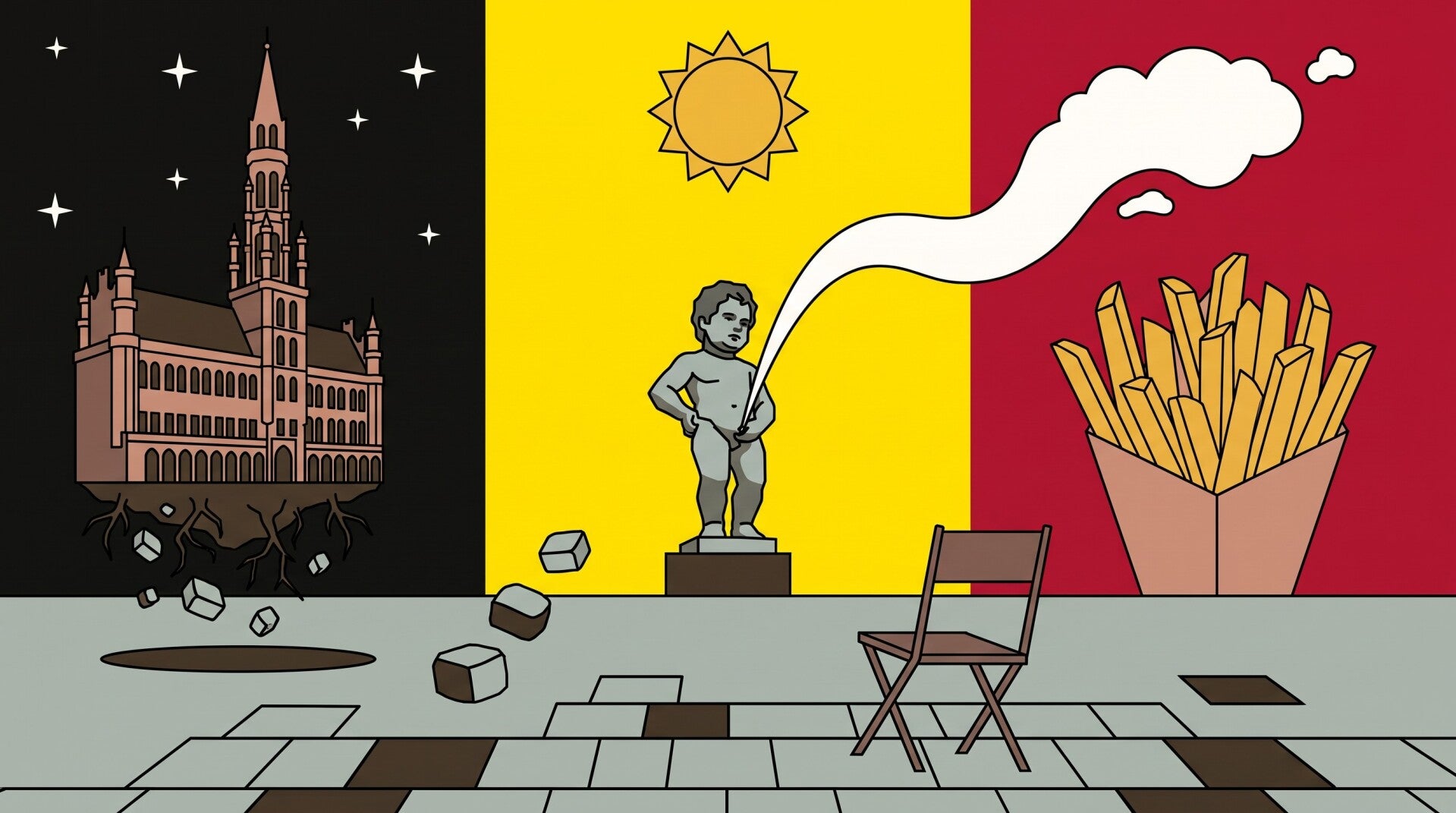
Belgium 1830–2030: An Unlikely Country Turns 200

Belgium came into being in 1830 almost by accident, from a revolt that nobody saw coming. It survived wars, a colony and a language struggle, built by people who rarely agreed on anything. In 2030, that unlikely country turns two hundred.

The Unlikely Nation - Belgium 1830-2030

Two hundred years ago, in 1830, a revolt gave birth to Belgium. Nobody had seen it coming, and very few predicted its future. Yet out of that accident grew a country with one of the most liberal constitutions in Europe, an industrial head start, a colonial past and a language struggle that redrew it again and again.

Two centuries on, Belgium is still anything but self-evident. It is a country of compromises, built by people who rarely agreed with one another. In 2030, it will celebrate its two hundredth birthday. Time to tell that story: not as a list of dates, but as a story about people.

Frère-Orban and the School War That Tore Belgium Apart

Belgium's First School War (1879–1884) represents a deeply contentious political and moral struggle between the Liberal government, led by Walthère Frère-Orban, and the Catholic Church regarding the direction of primary education. The pivotal law enacted on 1 July 1879, which was derisively termed the "law of misfortune" (loi de malheur) by the Catholic community, effectively stripped religious instruction from the public school curriculum. In response to this legislative change, bishops across the nation took decisive action by establishing their schools and withholding the sacraments from those who supported the public education system. As the political landscape shifted, a Liberal defeat in the elections of 1884 led to the repeal of this controversial law, highlighting the ongoing power struggle between secular and religious authorities in Belgium.

Read more »

René Magritte and the Pipe That Isn't a Pipe

The Treachery of Images (La Trahison des images) is a remarkable painting created in 1929 by the Belgian artist René Magritte. The artwork features a realistic depiction of a pipe alongside the phrase 'Ceci n'est pas une pipe', which translates to 'This is not a pipe.' This statement encapsulates the essence of the painting’s message: while it visually represents a pipe, it is ultimately just a painted image and not a functional object. Through this apparent contradiction, Magritte challenges viewers to question their assumptions and to consider images more critically.

Read more »

The Sluices of Nieuwpoort: How Water Saved Belgium

The flooding of the Yser plain was a strategic manoeuvre employed by the Belgian army in late October 1914 to halt the relentless advance of German forces along the Yser River. This controlled inundation involved the deliberate entry of seawater through the Ganzepoot lock complex located in Nieuwpoort, effectively filling the low-lying polder area situated between the river and the Nieuwpoort-Diksmuide railway embankment.

Read more »

Henri Pirenne: The Historian Who Gave Belgium a Story

Henri Pirenne (1862–1935) was the Ghent historian whose seven-volume Histoire de Belgique (History of Belgium, 1900–1932) gave the country a coherent past reaching centuries before 1830. During the First World War, as a deportee without access to any archive, he wrote a history of Europe. His work shows that a historical story does not become 'true' through certainty but through method: source criticism, honesty about what you don't know, and a willingness to revise your own story.

Read more »

Paul-Henri Spaak: the Belgian who put Europe on paper

Paul-Henri Spaak (1899–1972) was the Belgian socialist and foreign minister who chaired the negotiations for a European common market between 1955 and 1957. The Treaty of Rome is the treaty signed on 25 March 1957 that created the European Economic Community (EEC) and Euratom. Spaak's name heads the list of signatories: a small country turned out to be the ideal architect, precisely because nobody feared it.

Read more »

Liberation of Brussels 1944: joy beneath a burning palace

The liberation of Brussels ended more than four years of German occupation of the Belgian capital. On Sunday evening, 3 September 1944, shortly before 8 p.m., the first tanks of the British Guards Armoured Division rolled into the city while the Palace of Justice was still burning. The joy was immense, yet the initial weeks of freedom also revealed the fragile boundary between justice and revenge.

Read more »

Constant Permeke and the Myth of Latem's Light

Constant Permeke (1886–1952) lived in Sint-Martens-Latem from 1909 to 1912 but did not find his style there: at the time he painted under the spell of Emile Claus's Luminism. His heavy, unvarnished depictions of farmers and fishermen emerged only after the First World War, in England, Ostend, and, from 1929, Jabbeke. Flemish Expressionism, the movement Permeke came to lead, is a 1920s Belgian art movement that painted rural life in dark earth tones and simplified, massive forms.

Read more »

Marie Popelin: the Belgian woman barred from the bar

The Popelin affair was the 1888–1889 legal case in which the Brussels Court of Appeal, and then Belgium's Court of Cassation, refused to let Marie Popelin take the lawyer's oath. Popelin was the first woman in Belgium to earn a doctorate in law, and no Belgian law excluded women from the bar. The judges refused anyway, citing tradition and the "nature" of women.

Read more »

La Muette de Portici: the opera that made Belgium rise

La Muette de Portici is an 1828 opera by the French composer Daniel Auber about a popular uprising in Naples. After a performance at the Théâtre de la Monnaie in Brussels on 25 August 1830, the audience poured into the streets and started the riots that led to Belgian independence. Yet the opera did not set off that revolution by accident: the anger was already there, and the date had been announced in advance.

Read more »

Adolphe Max Surrendered Brussels, but Never His Judgement

On 20 August 1914, the German army entered Brussels, and no shots were fired. Mayor Adolphe Max (1869–1939), a Liberal, deliberately left the capital undefended to prevent a massacre. The German occupation of Brussels lasted from 20 August 1914 until November 1918. Max's surrender was not submission: five weeks later the Germans arrested him for defying them.

Read more »

Adolphe Quetelet and the Invention of the 'Average Man'

Adolphe Quetelet (1796–1874) was a mathematician, astronomer and statistician from Ghent who introduced the 'average man' (l'homme moyen) in 1835. The average man is a fictional person whose traits are the averages of all measurements taken in a population. With this idea, Quetelet laid the foundations of social statistics and of what we now call the BMI, but he also turned the average into a yardstick against which individuals were judged.

Read more »

Théodore Verhaegen: the believing father of free inquiry

Free inquiry is the principle that every claim may be tested by reason and evidence, with no church or state having the final word. On 20 November 1834, the Brussels lawyer Pierre-Théodore Verhaegen (1796–1862) and the educator Auguste Baron opened the Free University of Belgium (Université libre de Belgique), the forerunner of today’s ULB and VUB. It was a liberal answer to the Catholic university that Belgium’s bishops had founded in Mechelen that same year. Verhaegen only began using the term ‘free inquiry’ twenty years later.

Read more »

Create Your Own Website With JouwWeb