

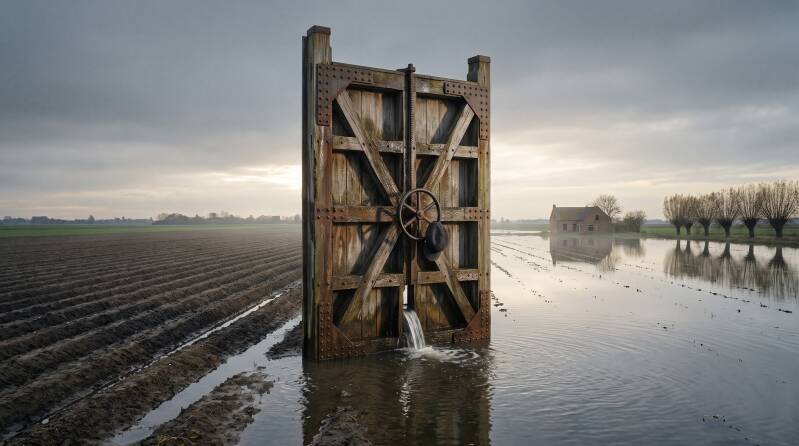
The flooding of the Yser plain was a strategic manoeuvre employed by the Belgian army in late October 1914 to halt the relentless advance of German forces along the Yser River. This controlled inundation involved the deliberate entry of seawater through the Ganzepoot lock complex located in Nieuwpoort, effectively filling the low-lying polder area situated between the river and the Nieuwpoort-Diksmuide railway embankment.
The success of this operation relied heavily on the expertise and insights of two civilians: Karel Cogge, who served as the supervisor of the Veurne North Water Board, and Hendrik Geeraert, a local bargeman from Nieuwpoort. Their knowledge of the waterways and the mechanics of the sluices proved crucial in executing this desperate yet necessary strategy.
On the evening of 29 October 1914 in Nieuwpoort, a critical situation unfolded. The bridge over the Ganzepoot lay in ruins, as Belgian engineers had destroyed it a few nights earlier under orders from French command. To access the gates of the Noordvaart canal, one had to traverse the lock gates, a perilous journey in darkness with German military positions alarmingly close by. Leading this risky endeavour was Hendrik Geeraert, a 51-year-old bargeman and father of eight, who, despite being illiterate, possessed invaluable practical knowledge. Accompanying him were Captain Fernand Umé, an engineer, and several soldiers, all of whom were unaware of the crucial timing required for the operation: raising the gates at high tide and lowering them before the ebb tide would allow the seawater to flow inward, reclaiming land that had been previously won from the sea. This difficult decision raised a poignant moral question faced by nations in crisis: is it justifiable to flood one's own territory to safeguard the greater good?
The Ganzepoot in Nieuwpoort: six waterways, one knot
The Ganzepoot, colloquially known as "Goose Foot", is a complex system of locks located on the eastern edge of Nieuwpoort, where six different waterways converge, including three shipping canals and three drainage canals. This intricate network plays a vital role in regulating the water levels of the low polders that lie behind the coastal defences. Under normal circumstances, the water drains into the sea during low tide, while high tide prevents seawater from encroaching on the land. However, in October 1914, this routine method of water management transformed into a desperate measure critical for survival. Following the fall of Antwerp, military leadership, together with King Albert I, designated the Yser River as the final line of defence on 14 October. By 22 October, German troops had crossed the river at the Tervate bend, pushing the Belgian army to its limits. Unfortunately, the individuals with the most intimate knowledge of the Ganzepoot locks were no longer available, as the army had evacuated lock master Geraard Dingens and his team on 19 October without properly documenting their whereabouts. A report from 1923 attributed blame for this oversight to military command, resulting in a situation where the army had to improvise under tremendous pressure.
Karel Cogge and the railway embankment plan
Karel Cogge, the supervisor of the Veurne North Water Board, played a key role in formulating a plan for the controlled flooding of the Yser plain on 25 October 1914. On that day, Prudent Nuyten, a staff officer, interrogated him in Veurne, the location of the Belgian military headquarters. At 59 years of age, Cogge had limited formal education and was unable to speak French; however, Nuyten, being originally from Ypres, could communicate with him effectively. The plan itself was straightforward in theory but incredibly challenging to implement. The railway embankment that stretched between Nieuwpoort and Diksmuide was to serve as a dam, with Belgian forces positioned behind it and German troops in front. However, every passage beneath the embankment had to be sealed off, which included four larger openings and over twenty smaller ones. Cogge possessed intimate knowledge of the location of all these passages, even those that were absent from official army maps.
Initially, Cogge suggested utilising the Noordvaart, the primary drainage canal, which had a flow capacity roughly three times that of the alternative options. However, military command deemed this approach too risky, as it would expose their actions to German observation. Consequently, Cogge and Captain Robert Thys opted to try an older sluice located further west, known as the Oud-Veurnesas or "Spanish lock." Unfortunately, this attempt to close the flood gates encountered difficulties; they initially shut on their own but subsequently allowed water to rise too slowly. Meanwhile, the frontline near Ramskapelle and Pervijze was close to collapse. Engineer Bourgoignie ultimately advised reverting to Cogge's original suggestion of using the Noordvaart. By 29 October, the authorities finally gave the order to proceed with this plan.
Four nights at the Noordvaart: the Yser plain goes under
The Yser plain began to flood over the course of four consecutive nights, starting on 29 October 1914, as seawater was allowed to flow through the gates of the Noordvaart at the Ganzepoot. Hendrik Geeraert assumed the responsibility of instructing Captain Umé's soldiers on the execution of the plan. Each night, the gates were raised at high tide and lowered at low tide, effectively trapping the incoming seawater. Despite not being a trained lockkeeper, Hendrik Geeraert's extensive knowledge of the water proved to be far more valuable than any formal title. Local accounts suggest that Geeraert wore a cap belonging to an assistant lockkeeper, allowing him to pass by the soldiers without suspicion. His familiarity with the waterways was crucial during this critical week.
The effects of this operation became apparent almost immediately. On 30 October, German troops were still able to cross the railway embankment at Ramskapelle, but by the following day, their advance was forced to retreat. By 1 November, the flooding had inundated an area approximately 15 kilometres long and up to 4 kilometres wide, leaving only farmhouses and sections of cobbled roads visible above the water. The Battle of the Yser effectively reached a stalemate, and the front in this region remained unchanged for the next four years. An engineer company under the leadership of Robert Thys was responsible for maintaining the flooding throughout the war, with Geeraert contributing his expertise to the effort.
Historians remain divided over the reasons for the decision to prepare for the flooding of the Yser plain only on 25 October 1914. Prudent Nuyten later claimed that the concept had occurred to him on 24 October. However, Lockmaster Dingens and Germain Van Marcke, a schoolteacher from Wulpen, asserted that they had already alerted military officers to this possibility in mid-October. Historian Luc Vanacker interprets the situation as a matter of timing rather than ignorance: while the French allies were eager to launch an offensive, the introduction of water did not align with their strategy. Nuyten contended that the army should first fulfil its combat obligations. The testimonies suggest that civilians proposed the idea earlier than the formal accounts reflect, even though the truth remains elusive.
The cost of seawater for the Yser polders
While the flooding of the Yser plain ultimately saved the Belgian army, the repercussions fell squarely on the Yser polders and the inhabitants who resided there. Lock master Dingens had forewarned military officers in mid-October that allowing seawater into the area would lead to long-term consequences, as salt would render the clay soil unsuitable for agriculture until it was eventually leached out by rain and time. The residents of the plain were forced to evacuate or found themselves trapped in a war zone. Four years of conflict left villages like Pervijze and Ramskapelle in ruins. Following the end of the war in 1918, these communities required extensive rebuilding. The farmers were powerless in this situation; a high command, under immense pressure, made decisions about their land in Veurne. From a secular humanist perspective, the decision may be defensible, but it was not an easy one to accept. The flooding effectively halted an invasion that threatened the freedom of the entire nation and ended the assaults in this sector, which had already claimed thousands of soldiers' lives. Prioritising human lives over land presents a moral dilemma, yet it is essential to acknowledge the costs honestly, ensuring that the stories of those who suffered are not overlooked.
Cogge, Geeraert and the battle for credit after 1914
The credit for the flooding in 1914 was initially attributed to military officers, with the contributions of civilians only receiving recognition later, and often in an unequal manner. Colonel Wielemans informed the King on 1 November 1914 that Commandant Nuyten, with assistance from Cogge, had initiated the effort. Just a few days later, on 5 November, King Albert I awarded the Knight's Cross of the Order of Leopold to both Nuyten and Cogge. Hendrik Geeraert was also honoured with a French medal in December 1914, but his Knight's Cross was only bestowed on him on his deathbed at the end of 1924. Geeraert passed away on 17 January 1925 in a charitable institution in Bruges. During his funeral, the mayor of Nieuwpoort remarked that the army had sustained Geeraert during his time at the sluices with alcohol, which ultimately deteriorated his health. In the 1950s, his portrait was featured on a 1,000-franc banknote, signifying a posthumous recognition of his contributions.
Many others who had played vital roles were never acknowledged. Lock master Dingens and teacher Van Marcke were omitted from the official narrative entirely. Captain Thys later characterised the honours awarded to Nuyten and Cogge as a blatant falsehood, while historian Vanacker noted that Thys himself had claimed credit for one of Cogge's ideas. Cogge firmly rejected any attempt to sign a statement that would attribute credit to Thys. This aspect of history serves as a reminder of the importance of free inquiry. The official narrative relied heavily on letters and reports from officers, who naturally documented their roles most thoroughly. As Vanacker points out, a claim does not equate to proof, and this principle forms the foundation of critical thinking. When one examines the sources side by side, it becomes evident that the life-saving knowledge originated from individuals at the grassroots level: a water board supervisor, a bargeman, a lock master, and a village teacher.
From the Yser plain to the Sigma Plan: who decides on flooded land?
In contemporary Flanders, controlled flooding is still employed, but now the objective is to protect people from potential floods. The Sigma Plan, which authorities implement along the Scheldt River, establishes designated flood areas, often using land that farmers previously cultivated. During storm surges, water is permitted to enter these controlled zones, thereby safeguarding towns and cities from inundation.
This modern approach presents a stark contrast to the past; currently, there is no war, and the processes of decision-making and consultation are far more structured than those that existed in 1914. Nevertheless, the fundamental question regarding the Ganzepoot remains relevant: who bears the burden of the consequences when choices are made to protect the collective? Furthermore, whose expertise is deemed valuable in such decisions: only the knowledge of those present at the decision-making table, or also the insights of individuals who possess a profound understanding of the waterways?
Frequently asked questions
Was flooding the Yser plain in 1914 the right decision?
From a secular humanist perspective, it was a defensible decision, albeit with significant consequences. The flooding effectively halted the German advance on the Yser in late October 1914, thus protecting the Belgian army and the last free stronghold in Belgium. However, the burden of this decision fell squarely on the residents of the Yser polders, who lost their land and homes without having a voice in the matter.
What is the Ganzepoot in Nieuwpoort?
The Ganzepoot, commonly referred to as "Goose Foot", represents the lock complex in Nieuwpoort, Belgium, where six waterways converge: three shipping canals and three drainage canals. This system plays a crucial role in managing the water levels of the polders situated behind the coastal defences. In October 1914, seawater was intentionally allowed to flow into the Yser plain through the Noordvaart canal at the Ganzepoot.
Who was Karel Cogge?
Karel Cogge (1855-1922) served as the supervisor of the Veurne North Water Board in Belgium. On 25 October 1914, he provided critical insights to the Belgian high command regarding how to execute the flooding of the area between the Yser and the Nieuwpoort-Diksmuide railway embankment. On 5 November 1914, King Albert I recognised his contributions by appointing him a Knight of the Order of Leopold.
How did Belgium flood the Yser in 1914?
Belgium accomplished the flooding of the Yser plain by manipulating the gates of the Noordvaart canal at the Ganzepoot in Nieuwpoort. The gates were opened at high tide and closed at low tide, allowing seawater to enter the area. For four consecutive nights, from 29 October 1914, an engineering team led by Captain Fernand Umé executed this plan, with assistance from bargeman Hendrik Geeraert. The Nieuwpoort-Diksmuide railway embankment served to contain the water on the Belgian side.
What damage did the flooding of the Yser plain cause?
The introduction of seawater rendered farmland on the Yser plain unusable for an extended period, as forewarned by lock master Geraard Dingens. Residents were forced to evacuate, and villages such as Pervijze and Ramskapelle remained on the front line for four years, resulting in widespread destruction. Following the end of the conflict in 1918, these areas required significant rebuilding.
Who got the credit for the Yser flooding of 1914?
The initial credit for the flooding was primarily awarded to Commandant Prudent Nuyten and Karel Cogge, both of whom were recognised as Knights of the Order of Leopold on 5 November 1914. In contrast, bargeman Hendrik Geeraert received the same honour only on his deathbed at the end of 1924. The official narrative completely overlooked lockmaster Geraard Dingens and teacher Germain Van Marcke, who had previously alerted officers to the flooding concept.
Sources
- Vanacker, Luc, "De IJzer, October 1914. Een slag te veel? Het idee en de timing van de eerste onderwaterzetting", Westvlaamse Gidsenkring Westhoek, 39 (2003), 3, pp. 1-21 (quoting primary sources: Colonel Wielemans' letter to King Albert I of 1 November 1914, lock master Geraard Dingens' unpublished account, the 1923 Bourgoignie report and the interviews in La Flandre libérale, June-July 1920).
- Demerre, Guido (Westfront Visitor Centre, Nieuwpoort), "Inundatie van oktober 1914: IJzervlakte onder water", VRT NWS, 23 October 2014.
- In the Flanders Fields Museum, see the educational dossier "De sluizen" (Ypres).
- Further reading (not consulted directly): Thys, Robert, Nieuport 1914-1918. Les inondations de l'Yser et la Compagnie des Sapeurs-Pontonniers du Génie Belge, Liège, 1922; Van Pul, P.A.A., "Oktober 1914. De initiële inundaties aan het Belgische front", Belgisch Tijdschrift voor Militaire Geschiedenis, 30 (1994), 7, pp. 541-563; Bijnens, Bert, "Wat herinnert in Nieuwpoort nog aan Hendrik Geeraert (1863-1925)", Bachten de Kupe, 41 (1999), 4, pp. 171-187.
Add comment
Comments