

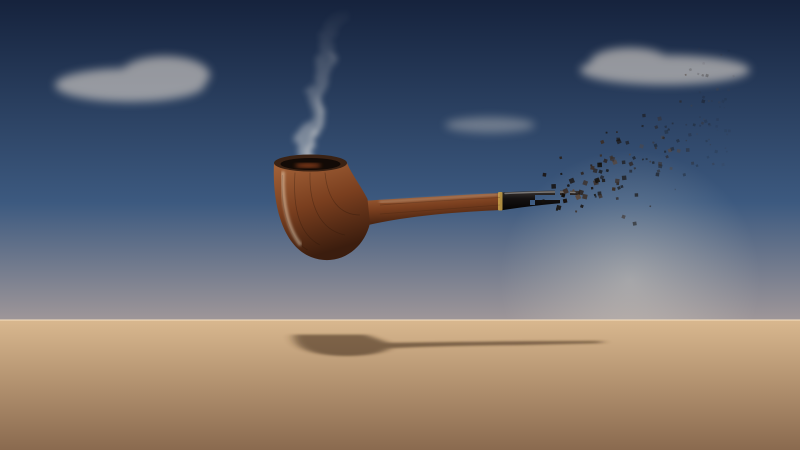
The Treachery of Images (La Trahison des images) is a remarkable painting created in 1929 by the Belgian artist René Magritte. The artwork features a realistic depiction of a pipe alongside the phrase 'Ceci n'est pas une pipe', which translates to 'This is not a pipe.' This statement encapsulates the essence of the painting’s message: while it visually represents a pipe, it is ultimately just a painted image and not a functional object. Through this apparent contradiction, Magritte challenges viewers to question their assumptions and to consider images more critically.
In the suburb of Le Perreux-sur-Marne, located to the east of Paris, in 1929, a man dressed in a suit and tie is seen leaning intently over a canvas. He paints with the precision of an accountant meticulously tallying figures, ensuring each stroke is deliberate and free of smudges. The canvas displays a pipe, rendered with such clarity that it resembles an illustration from a catalogue. The pipe is crafted from brown wood, featuring a black mouthpiece, and it reflects a soft sheen on its bowl. Below this intricate image, written in carefully formed cursive akin to that found in school exercise books, are the words 'Ceci n'est pas une pipe. 'This man is none other than René Magritte, who, at the age of thirty, finds himself struggling to sell his artwork. In a striking contradiction, he has just declared that what is depicted is not what it seems.
Or has he?
The Treachery of Images: a painting that contradicts itself
The Treachery of Images stands as René Magritte's most iconic painting, functioning like a riddle that invites viewers to engage with its simple yet profound answer. The pipe depicted on the canvas is not a pipe in the conventional sense; it is merely paint arranged in a way that resembles a pipe. One cannot fill it, ignite it, or smoke it. Magritte is often said to have elaborated on this point during discussions with those who contested the painting's meaning, although his original explanation has largely survived through various interpretations. Regardless, the message is clear and present on the canvas itself: anyone who asserts, "This painting is a pipe," is fundamentally mistaken.
In December 1929, Magritte further explored this concept in a written piece titled 'Les mots et les images' ('Words and Images'), which was published in the magazine La Révolution surréaliste. Through the use of small drawings, he illustrated how words, images, and tangible objects each follow their distinct paths. The original painting is now part of the collection at the Los Angeles County Museum of Art (LACMA). Surrealism, as an art movement, began to take shape in Paris in 1924 under the influence of poet André Breton. It sought to utilise dreams, the unconscious mind, and the unexpected to challenge and expand the boundaries of ordinary reality. Belgian Surrealism represented a branch of this movement, emerging from Brussels, characterised by a more restrained and calculated approach, and was often viewed by art historians as more sceptical of established doctrines, including those espoused by Breton.
Magritte and André Breton in Paris, 1927–1930
In 1927, René Magritte relocated to Le Perreux-sur-Marne with his wife, Georgette, in hopes of integrating himself into the community of Parisian Surrealists. However, it quickly became clear that he did not fit the mould Breton envisioned for the group.
The Belgian art philosopher Willem Elias refers to Breton as the "Pope" of Surrealism, a title that encapsulates the authoritative role he played within the movement. Breton was the architect of the manifestos, the arbiter of membership, and the enforcer who expelled those who deviated from his vision.
An often-repeated anecdote among biographers illustrates the extent of Breton's control. One evening at Breton's gathering, Georgette was wearing a small cross around her neck, which in some accounts was a sentimental heirloom from her grandmother. Breton insisted that she remove it, leading to the couple's departure from the gathering. Breton was not merely a caricature; his aversion to the Catholic Church stemmed from genuine beliefs—he perceived it as a force that had historically dictated the thoughts and emotions of individuals. However in this instance, he contradicted his principles. If one opposes an institution for policing beliefs, they cannot simultaneously engage in similar policing. Historians have various interpretations of the significance of that evening. By the end of 1929, Magritte's regular source of income through his Brussels gallery, Le Centaure, was also cut off, prompting the couple to return to Brussels in 1930.
Jette, 135 Rue Esseghem: a revolution in a suit and tie
From 1930 until 1954, René Magritte lived in a ground-floor apartment at 135 Rue Esseghem in Jette, a tranquil suburb of Brussels. During this period, he produced approximately half of his artistic output, often working in a corner of the dining room. His lifestyle was not that of a bohemian artist; instead, he lived akin to an office worker, and the bowler hat he frequently painted reflected this image. On Sundays, the Brussels Surrealists convened at his residence, among them prominent figures such as poet Paul Nogué, who was the group's theorist, and writer Louis Scutenaire.
Here lies the paradox of Magritte's existence. To sustain himself financially, he took on work in advertising. Alongside his brother Paul, he operated an advertising agency called Studio Dongo from a workshop located at the bottom of their garden. Thus, the very man who created a painting centred around deception also crafted images designed to persuade and sell. This duality is precisely why he possessed an acute understanding of deception from an insider’s perspective. Anyone involved in advertising is keenly aware of how an image can be manipulated to influence perceptions.
Ceci n'est pas une pipe as a lesson in free inquiry.
Viewed through the lens of secular humanism and the principle of free inquiry, The Treachery of Images serves as a concise guide for critical observation. The painting does not compel viewers to accept any assertions; rather, it encourages them to scrutinise what they perceive. Embracing free inquiry entails rejecting blind acceptance of authority, whether it be from a religious institution, a government, or even one’s own perceptions. Magritte, for his part, displayed little tolerance for those who attempted to interpret his works as containing hidden symbols or messages from dreams.
In 1968, the French philosopher Michel Foucault composed an essay regarding the painting, which he later expanded into a short book in 1973, both titled Ceci n'est pas une pipe (This Is Not a Pipe). Foucault's central argument posits that in this work, the relationship between word and image no longer reinforces one another, thereby unveiling the inherently problematic nature of their connection.
This interpretation reflects my understanding from a secular humanist viewpoint rather than an absolute fact: it embodies the subtle rebellion of Belgian Surrealism. It did not confront the church or monarchy overtly; instead, it challenged a more profound reflex—our tendency to believe whatever we are presented with. Institutions like churches, governments, and advertisers often employ images that assert 'this is the truth,' while Magritte counters with the assertion, 'this is not the truth.' Can a painting employ deception to convey a deeper truth? The answer seems to be yes, as that is the essence of the trick. Ultimately, the greatest deception lies in our habitual inclination to equate an image with the object it represents.
This is not a pipe in 2026: AI images and deepfakes
In 2026, the lesson imparted by René Magritte is more pressing than it was in 1929. In today's world, images can be generated depicting individuals stating things they never actually said or events that never took place, all through a simple command to a computer. This situation represents a parallel to Magritte’s exploration of visual deception, rather than a direct equivalence. Magritte was transparent in his deception: he deliberately inscribed his denial beneath the image in a manner accessible to all. A deepfake, conversely, conceals the fact that it is an artificial image.
Consequently, Magritte's phrase serves as a critical question to pose regarding any image in contemporary society. Where is the line that indicates what this is not? And if no one has inscribed that line, who stands to gain from your failure to recognise it?
Frequently asked questions
What does 'Ceci n'est pas une pipe' mean?
'Ceci n'est pas une pipe' translates to 'This is not a pipe,' and in the context of René Magritte's painting The Treachery of Images (1929), this statement holds literal truth. The canvas does not depict a real pipe; rather, it presents a painted representation of one. The artwork only appears to lie, ultimately demonstrating that an image can never fully encapsulate the essence of the object it represents.
What is The Treachery of Images by René Magritte?
The Treachery of Images (La Trahison des images) is an oil painting created by the Belgian Surrealist René Magritte in 1929. It features a pipe accompanied by the caption 'Ceci n'est pas une pipe' ('This is not a pipe'). The Los Angeles County Museum of Art (LACMA) currently houses this significant work in its collection.
Why did Magritte fall out with André Breton?
René Magritte experienced a conflict with André Breton, the influential leader of the Surrealist movement in Paris, who exercised strict control over group membership. An often-recounted anecdote highlights this tension: Breton insisted that Georgette Magritte remove her small cross from around her neck, prompting the couple to leave the gathering. Financial issues also contributed to the rift, as Magritte's regular income ceased at the end of 1929, leading them to return to Brussels in 1930.
Where did René Magritte live and paint in Brussels?
From 1930 to 1954, René Magritte resided at 135 Rue Esseghem in Jette, Brussels. It was in this apartment that he created about half of his artistic works, often in a small corner of the dining room. This residence has since been transformed into the René Magritte Museum. Later in his life, he moved to Schaerbeek, where he passed away in 1967.
What did Michel Foucault write about 'The Treachery of Images'?
The French philosopher Michel Foucault wrote an essay focused on Magritte's painting in 1968, which was later expanded into a book published in 1973 under the title Ceci n'est pas une pipe (This Is Not a Pipe). Foucault contends that in this artwork, the relationship between the word and the image fails to reinforce each other, thereby revealing the complexities and uncertainties inherent in the connection between signs and their meanings.
What does Magritte have to do with deepfakes?
Directly, there is no connection, as René Magritte passed away in 1967. However, when viewed through a secular humanist lens, his painting offers a relevant parallel: it illustrates that an image is not synonymous with the object it represents. The crucial difference is that Magritte openly acknowledged his deception, while a deepfake conceals its artificiality.
Sources
- Magritte, René, 'Les mots et les images', La Révolution surréaliste, no. 12, 15 December 1929 (primary source).
- Los Angeles County Museum of Art, collection record The Treachery of Images (This is Not a Pipe), 1929, acc. no. 78.7 (lacma.org).
- Foucault, Michel. Ceci n'est pas une pipe. Montpellier: Fata Morgana, 1973.
- Elias, Willem, Aspecten van de Belgische kunst na '45, chapter 'Het surrealisme' (willemelias.be).
- René Magritte Museum, 'The period in Jette (1930–1954)' (magrittemuseum.be).
- Brussels-Capital Region, listing decree Maison Magritte, Rue Esseghem 135, Jette (doc.patrimoine.brussels).
- Ottinger, Didier (ed.), Magritte. La trahison des images, exhibition catalogue, Centre Pompidou, 2016.
- Values framework: demens.nu and humanistischverbond.be (free inquiry, self-determination).
Add comment
Comments